want some cookies?
We use cookies to make your browsing experience amazing.


You’ve spent six months building a leadership programme. It’s good. It’s really good. You’ve got senior buy-in. You’ve got a snazzy name. You’ve even convinced someone in the C-suite to record an intro video.
Then you launch it.
The result? Two paltry sign-ups (and one was from Dave in Finance, who clicks on literally everything). #lolsadness
Sound familiar? You’re not alone. This is happening in every organisation, every week. Brilliant learning programmes are dying silent, expensive deaths. Not because the product is bad, but because nobody thought about how to actually get it in front of the right people in the right way.
That’s not a training problem. That’s a marketing problem. And I’ve conducted enough campaign autopsies to know exactly what’s killing them. So let’s crack open the coroner’s report.
CAUSE OF DEATH #1: YOU DIDN'T THINK ABOUT WHO YOU WERE TALKING TO
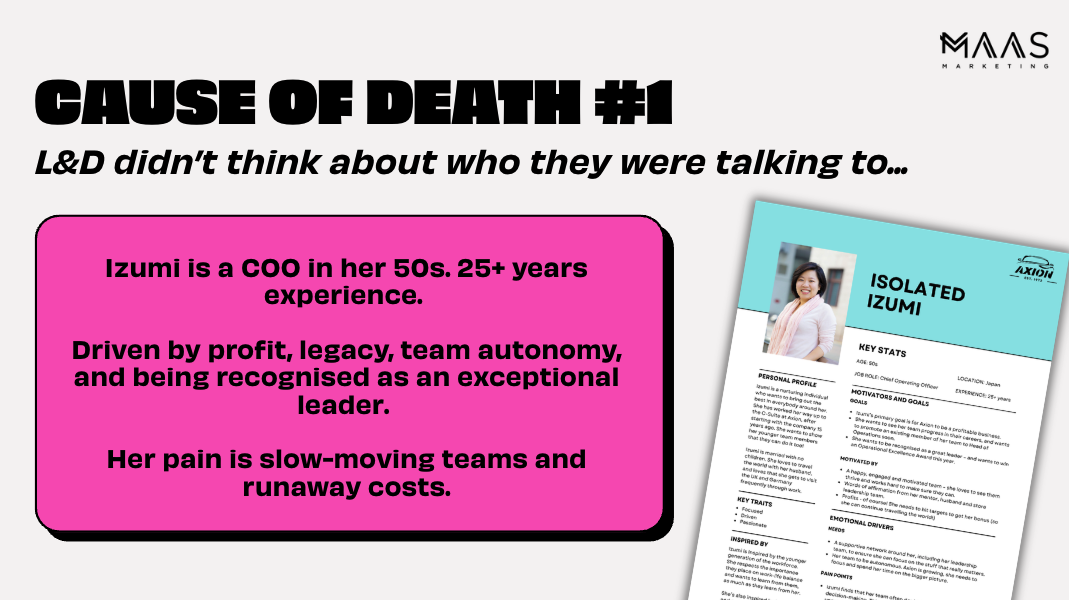
Meet Izumi. She’s fictional, but she’s based on every senior leader I’ve ever seen L&D try to reach.
She’s a COO in her 50s with 25 years of experience. She’s driven by profit, legacy, team autonomy, and recognition. Her pain points? Slow-moving teams. Losing pace with competitors. Not being seen as the innovative leader she knows she is.
Nobody thought about any of that when they wrote the launch email. Instead, she got this:
“Hi there. As part of our exciting AI literacy journey, the L&D team is thrilled to share details of our brand new programme. This blended learning experience has been carefully co-created with internal stakeholders and external SMEs to ensure alignment with our strategic people priorities. We’d love for you to get involved.”
Izumi read the first four words and deleted it. Because nothing in that email talks to her challenges. Not one word about competitive edge, innovation, leadership, or legacy. Just L&D being excited about things L&D made.
And those two things - L&D excitement and employee engagement - are not the same thing.
Here’s what they could have sent instead:
"Hi Izumi,
Did you know that three of Axion's closest competitors have already begun rolling out AI-assisted operations at leadership level? Decision-making is faster. Costs are lower. And the leaders driving that shift didn't wait for a mandate. They moved first.
The question for Axion isn't whether AI changes how we lead. It already is.
The question is whether our leadership team shapes that change, or responds to it.
APEX is a six-month programme built exclusively for Axion's senior leaders. Not to teach you what AI is, but to change how you operate. You'll leave with a team that moves faster, decisions you can defend with better data, and a function that's ahead of where Axion needs to be, not catching up to it.
The first session is a private briefing. No commitment beyond that.
Would Thursday work?"
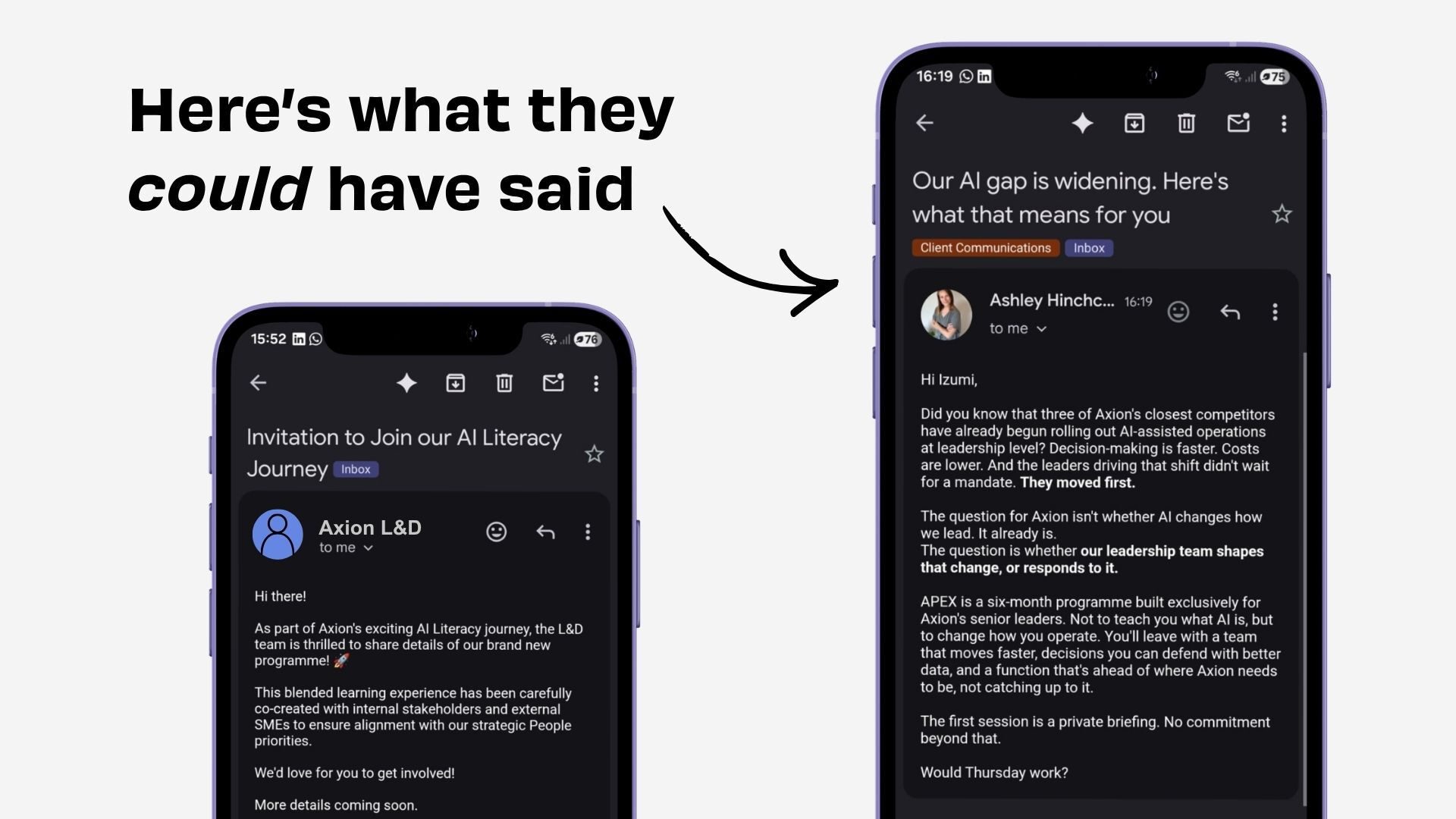
See the difference? The first email starts with “we.” The second starts with her. Her competitive landscape. Her risk. Her opportunity to lead.
This is persona work. And if you’re not doing it, you’re writing comms for yourself, not your audience. (If you want a deeper dive, I’ve written about how to actually use personas in learning comms and there’s a free persona-building template too.)
CAUSE OF DEATH #2: YOU FORGOT THE WIIFM
If you’ve ever followed me on LinkedIn, you’re probably sick of me banging on about the What’s In It For Me. But I keep banging on about it because it keeps getting ignored.
Most learning campaigns answer the question: “What has L&D built?" when they should be answering: “What does this do for me?”
Here’s what features-first messaging sounds like:
❌ “It’s a blended programme. It has coaching. There’s peer learning.”
Great. Does anyone outside of L&D even know what a blended programme is? I certainly didn’t before I started working in this space.
Here’s what WIIFM sounds like:
✅ "Your competitors are moving. This is how you keep pace. Your team is waiting for you to lead, and this is how you do it.”
Many of you have a mindset that kills campaigns before they even get off the ground, and it's this: we care about this programme, so surely they will too. We don’t say it out loud, but it informs everything we do. We assume people already care. We assume they want the learning. We assume enthusiasm is transferable.
It isn’t. You have to earn attention before you can ask for action.
Your employees are consumers. They’re used to Netflix algorithmically serving them content based on what they actually want. They’re used to brands like Nike making them feel something. And then they come to work and get “We’re excited to announce...”
“We’re excited to announce” is never a way to approach an audience. It starts with “we.” Who’s “we”? Why should I care? You’re excited, and that's nice. But that doesn’t make me excited. Izumi deleted that email in four seconds. I'm surprised it took her that long.
CAUSE OF DEATH #3: THE DESIGN WAS AN AFTERTHOUGHT
Stock photos of robots. A brain made of circuit boards. Both thoughtfully adorned with the catchy phrase: “New AI Learning Opportunity Available! Click Here to Get Started.”
You know exactly what I am talking about, because you've done it yourself. Heavily used stock photography, clichés and badly designed assets that aren’t remotely in keeping with the company brand. These assets are created in a rush, with no thought, at the very last minute.
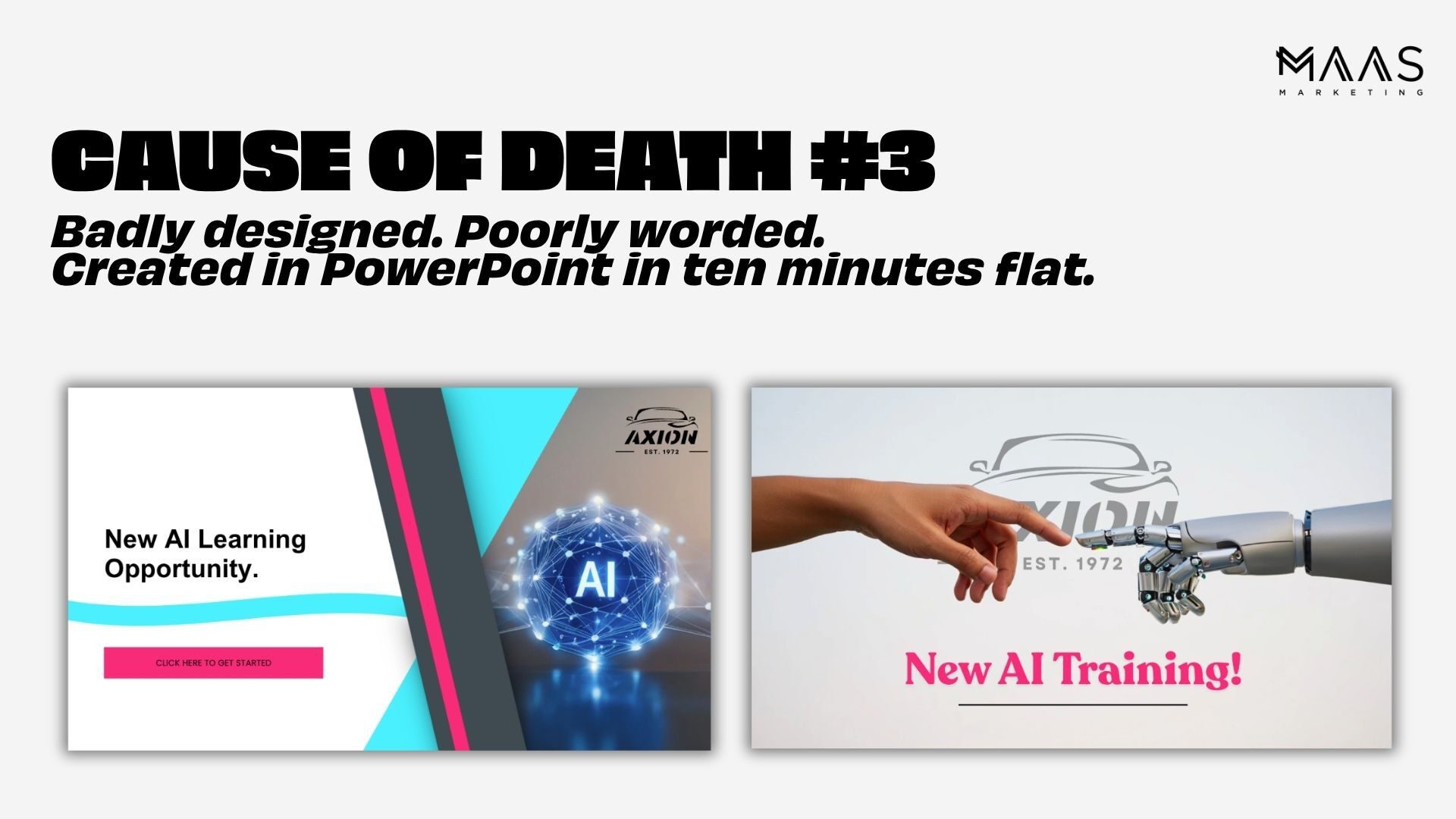
Design is just as important as the words you say. It’s a second opportunity to make a strong first impression. But in most internal campaigns, design gets even less thought than copywriting (which means it's getting none, because the copywriting barely got any).
If your leadership programme has a cutting-edge, premium brand identity and then your L&D team promotes it with a Canva template that looks like it was made during a fire drill, you can understand why the disconnect kills engagement.
Your designs and your copy need to work together. On brand. On message. With intention. Because people do make time for things they deem important, but your campaign has to earn that perception first.
CAUSE OF DEATH #4: YOU DID THE OLD LAUNCH-AND-VANISH 👻
Ah, the classic L&D move. You send a couple of emails. Get that Viva Engage post live. Sneak a slide onto the all-hands for one month. And then… poof. Vanished. Disappeared off the face of the earth. You're over here actively ghosting your employees whilst other brands are making them feel like the only person on the planet.
This is the Ellen DeGeneres to Houdini move, and it’s a classic L&D special. It’s also the exact reason Learning at Work Week drives me slightly round the bend. A week of frantic noise followed by eleven months of silence is not a campaign.
It’s a cymbal crash, when what you need is a drumbeat.
A campaign is a structured, goal-driven series of communications delivered consistently across multiple channels, designed to capture attention, build trust, and move a specific audience towards a desired action. Single emails, one-off posters, and quick bursts of activity don’t qualify.
Think about why Coca-Cola still advertises. Everyone knows what Coke is. They’re in practically every country on earth. But the second they’re not front of mind, maybe people don’t go “fancy a Coke.” So they keep showing up. Consistently. Relentlessly. If you want some more examples, check out this blog.
Your L&D offering needs the same consistency. Not the same budget, obviously (ain't nobody affording that). But the same principle still applies. Because if your audience forgets you exist, they won’t engage with what you’ve built, no matter how good it is.
CAUSE OF DEATH #5: YOU SKIPPED THE STRATEGY ENTIRELY
You thought you’d send some emails, do a Viva Engage post, and get the leadership team to mention it once. That was the plan. Except it wasn’t a plan. It was a to-do list. And there’s a difference.
The thinking behind most failed campaigns boils down to one dangerously cosy assumption: if you build it, they will come. And that's if thinking has even occurred with regards to the campaign; in many cases it's a cobbled-together, half-hearted, last-chance-saloon approach to employee engagement.
This is what I call the "Field of Dreams fallacy" and it lives rent-free in L&D. We operate on the belief that because we’ve made something great, people should care about it. And then we build our comms, our designs, and our timelines around that assumption, which sadly sets us up to fail from the start.
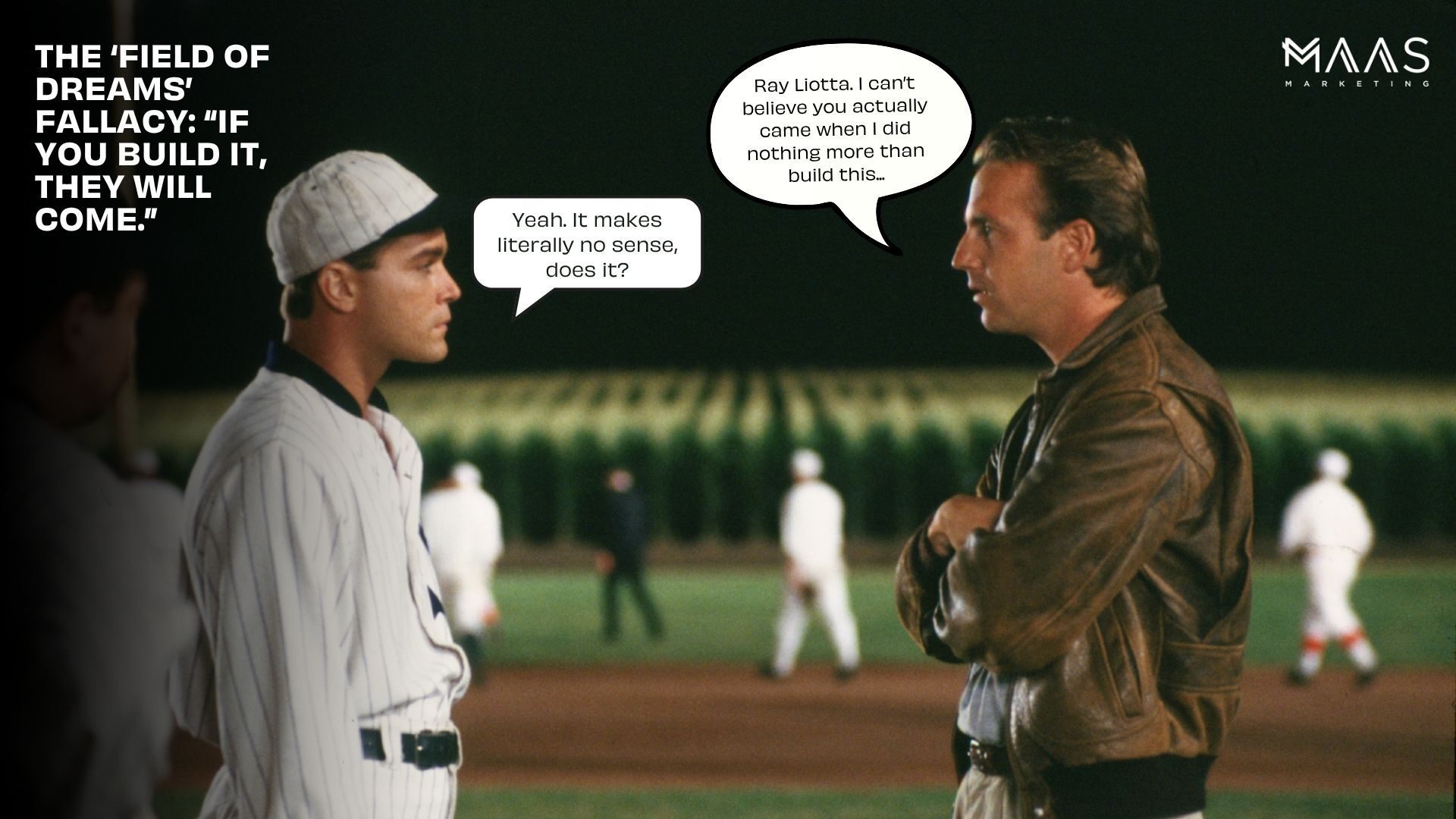
Imagine Tesla launching in the UK by building showrooms (your LMS), filling them with beautiful products (your learning content), and then… waiting. No advertising. No marketing. No reason for anyone to walk through the door. Of course nobody showed up.
That’s what happens every time L&D builds a programme and assumes the sheer existence of it is enough to drive engagement. It isn’t. Features don’t sell. Features don’t answer the WIIFM. You need a strategy that positions your offering as a pain reliever or a gain creator for the actual human being you’re trying to reach.
WHY DO EMPLOYEES IGNORE TRAINING? (IT'S NOT WHAT YOU THINK)
Here’s what most L&D teams get wrong: they think their audience is at the “action” stage of the decision-making journey. Ready to sign up. Ready to engage. Just keenly waiting for the email. Reality though? They’re not. Not even close.
What's the decision making journey? Well here's a helpful diagram for you (and a much more detailed blog here if you care to explore further).
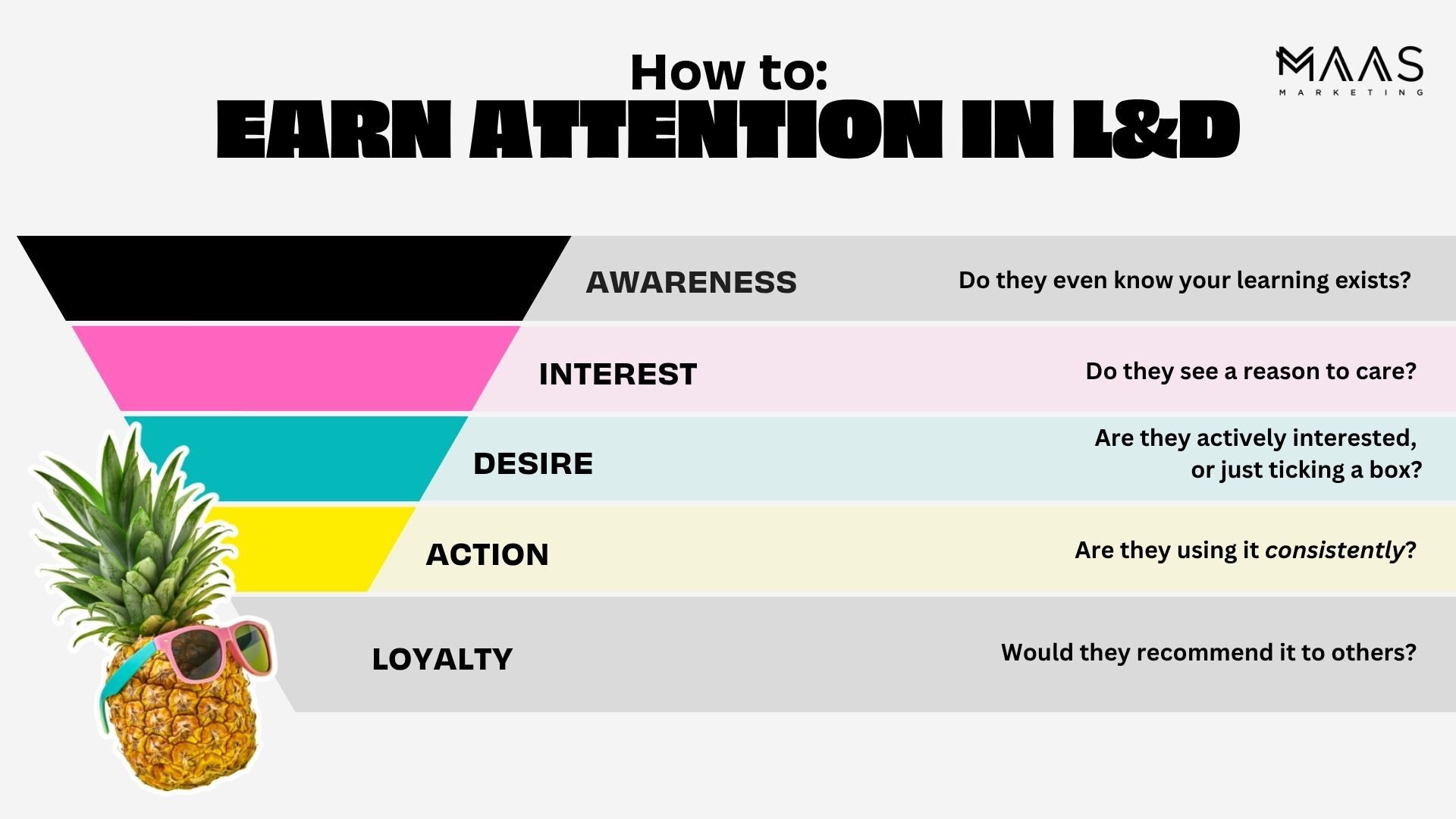
Most employees are stuck somewhere around awareness, or below it. They might have a vague idea of what’s available. They don’t really know where to find it. And they definitely don’t understand the value proposition of doing it.
But then L&D communicates with them as if they’re ready to take action (which is like, four stages away). “Go sign up.” “We’d love you to take part.” You’re asking someone who doesn't really know wtf you're talking about, and hasn’t even decided whether this is relevant to them, to commit their most precious resource: time.
That’s like proposing on a first date (wholly inadvisable). You’ve skipped about four stages of relationship-building, and now you’re wondering why they’re not interested. Or in the case of the former, running a country mile.
Marketing has known for decades that one-off interactions don’t change behaviour. There’s something called the Rule of Seven. Whilst it’s old school, the principle still holds. People need to encounter your message multiple times, across multiple channels, before they’ll act on it. Strategic repetition. Effective frequency. Multi-touchpoint campaigns.
You know this too. Learning science is incredibly supportive of evidence-based techniques like spaced repetition to embed knowledge and behaviours over time. This is literally L&D's version of the rule of seven. But what do we do instead? We sends one email and genuinely wonder why nobody signed up.
HOW TO BUILD A LEARNING CAMPAIGN THAT DOESN'T DIE ON ARRIVAL
If any of this feels uncomfortably familiar, you’re not alone. I see this pattern in every organisation I work with. But the good news is that it’s entirely fixable. Here’s where to start:
- Start with personas, not programmes. Before you write a single word of comms, understand who you’re talking to. What drives them? What keeps them awake at 2am? What would make them think “this is worth my time”? If you can’t answer those questions, you’re not ready to communicate yet.
- Lead with the WIIFM, not the features. Nobody cares that your programme is “blended” or “co-created with stakeholders.” They care about what it does for them. Frame every communication around the benefit to the audience, not the excitement of the team that built it.
- Invest in design that earns attention. Your comms should be on brand, considered, and intentional. If it looks like it was made as a last-minute scramble (because, let's be honest, it was) it’ll be treated accordingly.
- Build a campaign, not a single interaction. Multiple touchpoints across a sustained period. Use your intranet, your messaging platforms, your all-hands, your digital screens, your people and managers and even the back of the toilet door if you need to. Remember: a drumbeat, not a cymbal crash.
- Use behavioural science. Urgency. Storytelling. FOMO. Social proof. These aren’t gimmicks, they’re the exact triggers that consumer brands spend billions on because they work. There’s no reason you can’t apply them internally.
- Match your message to where your audience actually is. If they’re at the awareness stage, talk to them like they’re at the awareness stage. Don’t ask for action when you haven’t earned attention yet.
FAQS: LEARNING CAMPAIGNS THAT FAIL
Why do most learning campaigns fail?
Because they’re not campaigns. They’re one-off communications that comprise of things like a single email, a poster, or a Viva Engage post. Further to that, they're built on the assumption that if you tell people something exists, they’ll engage with it. Real campaigns require multiple touchpoints, persona-driven messaging, and strategic repetition over time.
How do I get employees to actually complete training?
Stop leading with what you’ve built and start leading with why it matters to them. Answer the What’s In It For Me in every single communication. Frame the training around their pain points, ambitions, and challenges, not around the features of the programme. Benefits > features all day. Every day.
What’s the difference between internal comms and a learning campaign?
Internal comms tells people something exists. A learning campaign earns their attention, builds trust, creates desire, and drives action over time. One is a broadcast. The other is a strategy.
How many touchpoints does a learning campaign really need?
There’s no magic number, but the Rule of Seven is a strong reminder that people need to encounter a message at least seven times before they act. The key is multi-channel consistency — email, intranet, messaging platforms, meetings, physical spaces — delivered as a sustained drumbeat, not a single burst. If you think this is boohockey, but are using spaced repetition in your learning dev, I am not going to be impressed 🙈
Is marketing really necessary for internal learning programmes?
Yes. Your learners are consumers and your learning offering is a product. Products do not ever sell themselves, not externally, and certainly not internally. If you’re spending thousands on building great learning and nothing on getting people to actually use it, you’re signing your own death certificate.
STOP SIGNING YOUR OWN DEATH CERTIFICATE
If you build great products but don’t think about how to get them in front of the people who should be using them, you’re wasting your budget, your time, and your credibility.
The organisations that get this right don’t just see better completion rates. They see less chasing, fewer eye-rolls, and an L&D function that’s associated with value rather than admin. They see 82% engagement. They see real learning impact.
Your learners are consumers. Your learning offering is a product. And the sooner you stop thinking Field of Dreams and start thinking like a marketer, the sooner your campaigns will stop dying three days after launch.
Wanna get started? My 100 Marketing Hacks is jam-packed full of instantly applicable tactics and actions that can transform your L&D function in a week! Download it now 👇
About MAAS Marketing
MAAS Marketing is a boutique marketing agency exclusively for People functions. We help L&D, HR, and Talent teams drive real engagement through proper marketing strategy, not more content. Clients include HSBC, Capgemini, Coca-Cola, Booking.com, Sainsbury’s, and MetLife. If you want your campaigns to stop dying, let’s talk.