want some cookies?
We use cookies to make your browsing experience amazing.


HONESTLY? NO ONE IS THRILLED ABOUT YOUR COMPLIANCE TRAINING.
Nobody wakes up excited about mandatory training.
Not your employees. Not your managers. Not even you, if we’re being honest.
And yet, every year, L&D teams across the globe launch the same tired compliance 'campaigns' (I use the term campaign very loosely). You know what I mean: a mass email from someone in leadership nobody’s ever met, a SharePoint banner that blends into the furniture, and a deadline that everyone ignores until HR starts chasing.
Then you sit there wondering why completion rates are at 34%.
Honestly? Your compliance training isn’t failing because employees don’t care about compliance. It’s failing because nobody gave them a reason to care about doing it.
That’s a marketing problem. And marketing problems have marketing solutions. Read on 👇
WHY DON'T EMPLOYEES COMPLETE MANDATORY TRAINING?
Let’s be clear, mandatory training exists for a reason. Data protection. Health and safety. Anti-bribery. These aren’t tick-box exercises invented to ruin a Tuesday (although they tend to accomplish that task rather well 🤣). They protect your organisation, your people, and in some cases, keep someone out of prison.
The content isn’t the problem. The communication is the problem.
Most compliance campaigns are built on one fundamental (wrong) assumption: that because something is compulsory, you don’t need to sell it. Trust me when I say you do. Desperately.
Compulsion doesn’t create engagement. It creates resentment. And resentment creates 34% completion rates, three chaser emails, and a terse conversation with the Head of People about why nobody takes learning seriously.
If you want employees to actually complete mandatory training, and complete it promptly (without being nagged), you need to market it.
WHAT "MARKETING" COMPLIANCE TRAINING ACTUALLY MEANS
It doesn’t mean turning your GDPR module into a viral campaign with a mascot called 'Gary Data'. #RipGaz
It means applying the same basic principles that every consumer brand uses to get people to pay attention, feel something, and take action, simply applied to your internal audience.
That looks like:
Leading with WIIFM (“What’s In It For Me”) — not “the business needs you to complete this” but “here’s why you should care”
Creating a campaign — not a single email blast, but a multi-touchpoint communications plan that builds awareness, drives interest, and converts to completion
Segmenting your audience — because a frontline worker and a senior manager do not need the same message, the same channel, or the same framing
Making the deadline feel urgent — not bureaucratic
None of this is rocket science. But none of it is what most L&D teams are currently doing either.
WHY IS COMPLIANCE TRAINING ENGAGEMENT SO LOW?
Before we get to what works, let’s quickly autopsy what doesn’t. Because chances are, at least three of these are familiar.
1. The “Because We Said So” Email
The message is sent from a generic L&D inbox. The subject line reads “Action Required: Complete Your Annual Compliance Training.” The body copy contains four paragraphs about regulatory obligation. Nobody reads past line two.
2. The One-And-Done Launch
One email goes out on the first of the month. You wait. Nothing happens. You send a reminder on the last day. A panic of completions occurs. You report the numbers. Repeat next year.
3. Zero Audience Segmentation
The same email goes to the entire company. The person who joined three weeks ago gets the same message as the person who’s been there fourteen years. Nobody feels spoken to. Everybody ignores it.
4. No WIIFM
The communication focuses entirely on what the organisation needs. Compliance. Risk. Regulation. What about what the employee gets out of it? Confidence. Protection. Knowing their rights. That’s the angle, and it’s almost never used.
5. Launch and Disappear
The campaign ends when the deadline hits. There’s no reinforcement, no embedding, no attempt to connect the training to real-world behaviour. Three weeks later, nobody remembers what they clicked through.
HOW TO ACTUALLY MARKET MANDATORY TRAINING: A FRAMEWORK
Here’s a simple approach that actually works. Even when you've got limited resource, limited budget, and a thoroughly frazzled team of one.
STEP 1: BUILD A CAMPAIGN, NOT A COMMUNICATION
A campaign is a series of planned, connected touchpoints designed to move someone through a journey all the way from “I’m vaguely aware this exists” to “I’ve done it and I understand why it matters.”
For a mandatory training campaign, that journey looks like:
Awareness:They know it’s coming before it lands in their inbox
Interest: They understand why it matters to them
Desire: They feel a reason to do it now, not on day 29
Action: They complete it
Loyalty: They don’t resist next time
One email achieves awareness. That’s it. You need at least four to six touchpoints across multiple channels to move someone to action. Plan accordingly.
STEP 2: LEAD WITH WIIFM EVERY. SINGLE. TIME.
Stop opening with “it’s that time of year again” or “as part of our regulatory requirements.”
Start with the employee (mad notion, I know).
What does completing this training mean for them? What happens if they don’t understand this information? What real-world situation does it protect them from?

Same information. Completely different reason to care.
STEP 3: SEGMENT YOUR AUDIENCE
You don’t have one audience. You have several, and they care about different things.
A frontline employee completing a health and safety module wants to know: will this keep me safe?
A manager completing the same module wants to know: how do I protect my team, and what am I liable for if something goes wrong?
A senior leader completing a fraud awareness module wants to know: what are the reputational and legal risks I need to be across?
Same training. Three very different WIIFM angles. Segment your communications accordingly (even if it’s just two or three versions of the same email) and watch your engagement shift.
STEP 4: USE MULTIPLE CHANNELS
If your entire compliance campaign lives in email, you’re already losing.
Not everyone is in their inbox. Some people are on the shop floor. Some people live in Teams or Viva Engage. Some people respond to a manager mention in a team meeting. Some people notice a poster in the break room (when it’s actually good).
Map your audience’s channels. Then use them. Deliberately. With consistent messaging across all of them.
STEP 5: CREATE A DEADLINE THAT MEANS SOMETHING
“Please complete by 31st March” isn’t urgent. It’s a date. Urgency comes from consequence, not a calendar. If you really want results, connect the deadline to something real. Some ways to think about it:
What happens if they miss it? (Access removed, escalation to line manager, regulatory audit risk)
What happens if they do it now? (Peace of mind, compliance confirmed, ticked off the list before the quarter-end rush)
You don’t need to terrify people. But you need to make the deadline feel like it matters. Because it does.
WHAT A GOOD COMPLIANCE CAMPAIGN ACTUALLY LOOKS LIKE
Here’s a quick example of a very rudimental, simple five-touchpoint compliance campaign structure:
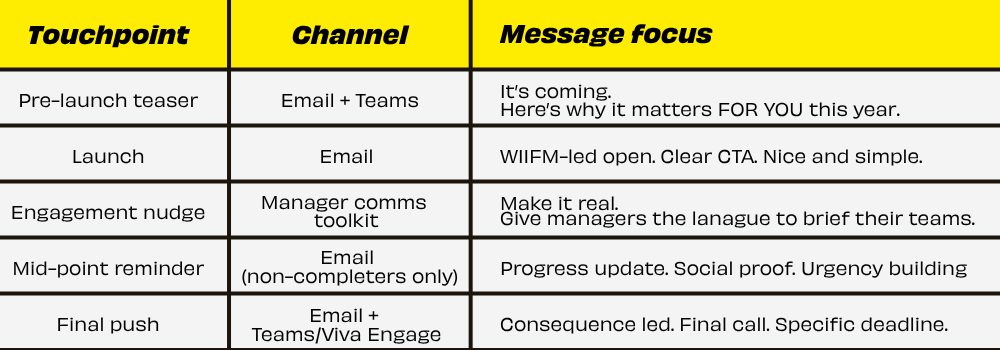
This isn’t complicated. It’s just planned. Which is more than most compliance campaigns ever are.
FREQUENTLY ASKED QUESTIONS
How do you increase completion rates for mandatory training?
Stop relying on a single email and a deadline. Build a multi-touchpoint campaign that leads with WIIFM - what’s in it for the employee, not just the organisation - and use segmented messaging across multiple channels. Completion rates improve when employees feel spoken to and understood, not administered at.
What is the best way to communicate mandatory training to employees?
Segment your audience, lead with consequence and relevance rather than obligation, and give managers the tools to reinforce the message in team settings. Email alone isn’t enough. Layer in Teams, Viva Engage, manager comms, and where appropriate, physical channels too.
How do you make compliance training more engaging?
Engagement starts way before the training even starts because it starts with how you market it. Frame the content around real scenarios employees recognise, connect it to their specific role and risks, and create urgency through consequence rather than just calendar dates.
Why is mandatory training completion so low in most organisations?
Because most organisations treat mandatory training as an administrative task rather than a communications challenge. One email, one deadline, zero segmentation, zero WIIFM. Employees are busy and distracted and if you don’t give them a compelling reason to act now, they won’t. It really is that simple.
How do you write a compliance training email that people actually read?
Ditch the regulatory opener. Start with the employee, be that a scenario, a question, or a consequence they'll recognise. Keep it short with just one clear call to action. And for the love of everything, don’t send it from a generic L&D inbox at 9am on a Monday.
THE BOTTOM LINE
Mandatory training isn’t optional. But engagement with it absolutely is.
Your employees will complete it if you give them a reason to care, communicate it like marketers rather than administrators, and treat them like the busy, distracted human beings they are. That’s not a training design problem. That’s a marketing problem, and it’s entirely solvable.
The organisations that get this right don’t just see higher completion rates. They see faster completions, fewer chasers, less friction with line managers, and an L&D function that’s associated with relevance rather than obligation.